- - - - - - - - - - - - - - - - - - - - - - - - - - - - - - - - - - - - - - - - - - - - - - - - - - - - - - - - - - - - - - - - - - - - - - - - - - - - - - - - - - - - - - - - - - - - - - - - - - - - Stephen Lyn Bales, editor

Monday, September 14, 2015

Tennessee Jones visits Ijams in search of dem bones


"I'm the brains. You're the brawn." Pause...."Say, whattttt?"

If adventure has a name, it must be Indiana Jones.

Ijams was honored to have Indy and his Raiders "girlfriend" Marion Ravenwood visit the camp kids during Tall Tale Week this summer. 

Well...it wasn't exactly Indiana himself, but rather his older brother Tennessee Jones, who has quite a large chip on his shoulder because his kid brother gets all the attention. After all, who was first? Tennessee became a state in 1796, and Indiana in 1816. And, Tennessee Jones taught his younger sibling Indiana everything he knows. (And his strong-minded, sassy girlfriend Mary Eaglewood taught TN Jones everything he knows.)

As she says, "I'm the brains. You're the brawn."

As the tall tale goes, Indiana pursues "new junk"—crystal skulls, golden goblets, chests full of ghosts, all man-made trinkets—while Tennessee Jones searches for the truly old, old Mesozoic things, namely dinosaur fossils.

Word had gotten to TN Jones that a possible paleo-site had been discovered at Ijams by local Rastafarian, Ben-jamin Nanny, and the camp kids went on a dino dig just like true paleontologists.

And you'll never guess what they found. 

Thanks, Jenny! Great job in the role of a sassy girlfriend.

- Stephen Lyn Bales 

Tennessee Jones shows the camp kids a true Mosasaurus fossil while Eaglewood straightens him out on the details.


Ijams staffer Augusta imitates how a T-Rex used its front legs.


•

Wednesday, September 9, 2015

TN Naturalists @ Ijams class studies aquatic life


Let's go exploring!

As summer is beginning to wind down, the TN Naturalists @ Ijams class of 2015 hit the water.


We have several ponds, a lake, a creek and we border the Tennessee River, all perfect for the class called Tennessee Waters: Aquatic Systems.

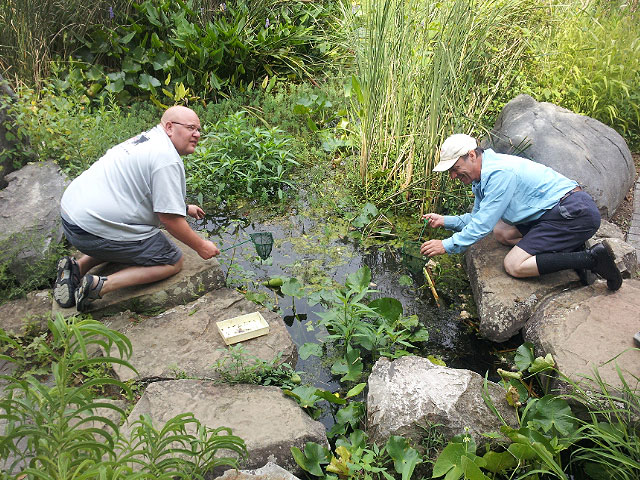
As part of the class, Jen Roder and Stephen Lyn led the group on a search for aquatic life in some of the watery places at the nature center.


Saturday, September 5, 2015

WVLT 8's Alan Williams reports on the freshwater jellies @ Ijams


The freshwater jellyfish @ Ijams made WVLT 8's 6 o'clock news last night. And who doesn't prefer a nice miniature aqueous critter story to a convenience store robbery or home break in?

News anchor, 30-year veteran Alan Williams, has worked for all three local TV news departments: WBIR, WATE and now WVLT. He's also from Knoxville, so he knows a good local story when he hears one.

Alan and photo journalist Keith Smith met me at Mead's Quarry Lake yesterday and we talked jelly, i.e. gelatinous umbrella-shaped bell cnidarian with trailing stinging tentacles and with adult medusa that pulsate for locomotion. So what could be more interesting than that?

The adult jellyfish medusa will be gone soon, so this weekend is a good time to rent a canoe, kayak or paddleboard from River Sports at Ijams and see them for yourself. But keep in mind, you're looking for penny-sized transparent jellies in a 25-acre lake. Patience and sharp eyes required.

For Alan's story click: Jellyfish found in East Tennessee.

- Stephen Lyn Bales

WVLT News Anchor Alan Williams with co-anchor Amanda Hara
WVLT Photo Journalist Keith Smith
Paddleboarders searching for jellies.

•

Monday, August 31, 2015

Cooper spots bald eagle from Ijams boardwalk

Bald eagle. Photo by Chuck Cooper

To be a truly great wildlife photographer, it helps if you have an expensive camera and lens. But, the one thing that is paramount in your toolbox, the one thing you have to have is patience. Patience with a capital "P."

Photographer Chuck Cooper often visits Ijams on the weekends and spends time in and around the Visitor Center. He also slowly walks the trails. 

Last Saturday, he was on the boardwalk overlooking the Tennessee River, when he spotted the above bald eagle across the water on the opposite shoreline. Chuck quickly snapped a few photos, then he settled in to wait. He was hoping that when the eagle flew it would fly towards him and maybe even swoop down to catch a fish.

The regal raptor stayed perched for over a hour. Chuck waited. Any wildlife photographer needs to be able to play the waiting game with fingers crossed. 

Alas, this time the eagle chose to fly the opposite direction and that great eagle-in-action-shot he was dreaming about will have to wait.

Thanks, Chuck. Ijams appreciates all you do!

- Stephen Lyn Bales

Friday, August 28, 2015

Wonder of Hummingbirds Festival at Ijams was best yet


By Vickie Henderson

Ruby-throated Hummingbird migration is in full swing in Tennessee making this an exciting time of year for hummingbird lovers! And a perfect time to have a festival in their honor.


Photo by Jody Stone


Last Saturday, August 22, the Knoxville Chapter of the Tennessee Ornithological Society and Ijams hosted their fifth annual Wonder of Hummingbirds Festival in Knoxville and the people attending were enthusiastic and eager to enjoy the many nature activities offered by the festival.

Organized by talented KTOS member, Billie Cantwell, the event attracted more than 1300 visitors who enjoyed hummingbird banding, nature walks, wildlife demonstrations, expert speakers, food, arts and crafts vendors and exciting children's activities!

Photo by Tom Howe
The popular highlight of the event is the hummingbird banding demonstrations offered by Mark Armstrong, Master Bander of hummingbirds and songbirds.

Photo by Susan Baumgardner
Mark Armstrong examines a hummingbird. Photo by Jody Stone

Volunteer Andy Troutman removes a male Ruby-throated Hummingbird from one of the bander's traps. Hummingbirds enter the trap to access the feeder and a door is lowered with an attached line. 
Photo by Susan Baumgardner.
Once removed from the trap, the hummer is placed in a mesh bag and transported to the bander.  
Photo by Jody Stone  

Mark first checks the hummers legs to be sure there is no current band. He then secures a numbered band around its leg and examines the hummer for age, sex and health. Measurements are recorded for the tail and beak and the belly is checked for fat to help determine overall health. If the individual is a juvenile male, he also records the number of red feathers on the throat. Photo by Susan Baumgardner.


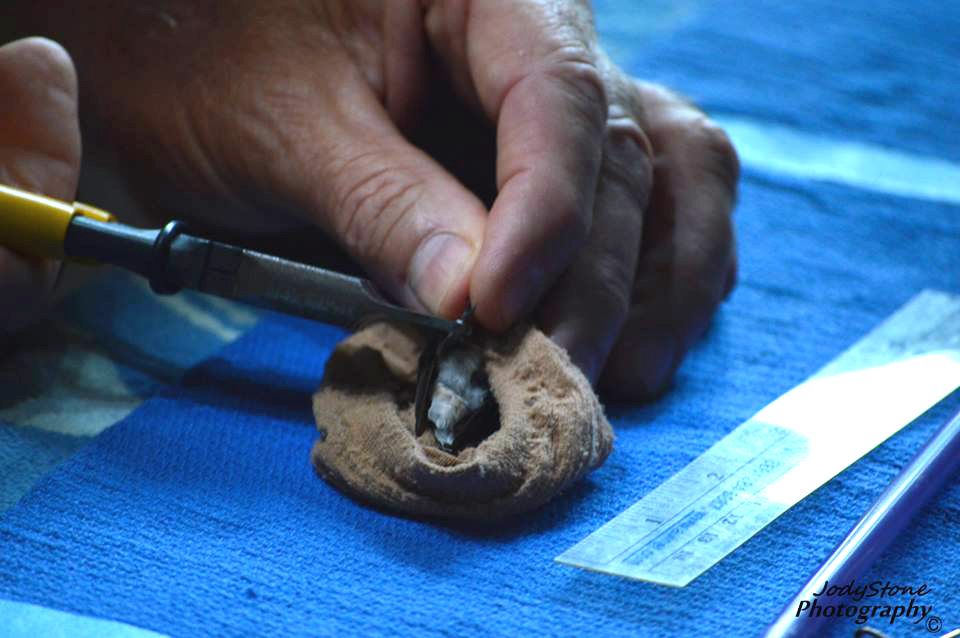
Armstrong attaches a numbered band to a hummingbird's leg. The small stocking covers the hummers head and helps to keep it calm. Watch the video below to see banding in progress. Photo by Jody Stone.


Patty Ford gives visitors a close look at a hummingbird before release and below, she gently places a hummingbird in a child's hand for the release. 
Photo by Susan Baumgarder.


The banding station banded 28 hummingbirds and had one male re-capture that was originally banded at the festival three years ago. The average life-span of a male hummingbird is 1.4 years and the oldest recorded male hummingbird was five years old. Our re-captured bird is doing well! Photo by Jody Stone. 


The male Ruby-throated Hummingbird shown above is molting feathers, meaning the old worn ones are falling out and being replaced with new ones. Tiny white tubules, that become the feather's shaft, hold the feathers as they grow. Molting during migration is a sign of health, according to Master Bander, Mark Armstrong. It means the hummingbird has enough energy reserves, or fat stored, for both migration and healthy growth.
Photo by Vickie Henderson. 

Thank you, Billie!

For more information or history of the festival go to: Vickie Henderson Art