 |
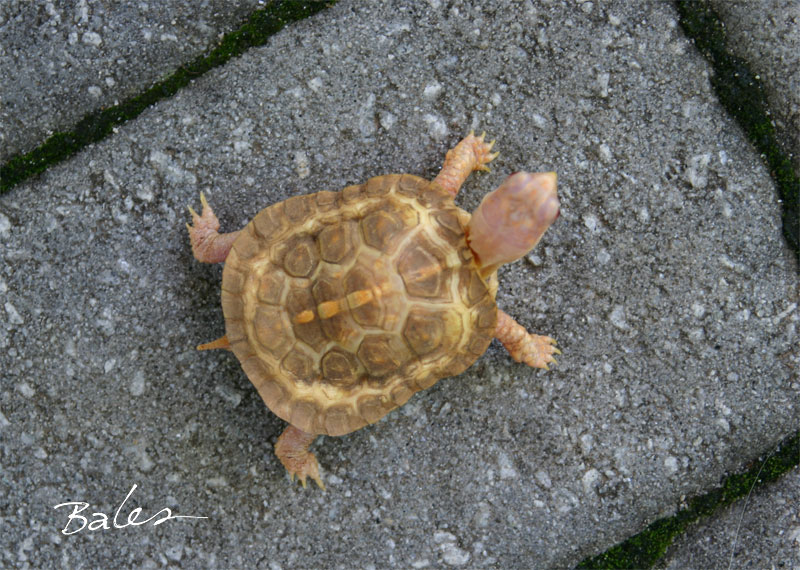
| Albino eastern box turtle (Terrapene carolina carolina)
The albino eastern box turtle that lives in the Exhibit Hall is celebrating its second anniversary at Ijams.
The tiny turtle was found by Aaron Bullock, at the time he was four-years-old. He named it "Space Rocket." The Bullocks called TWRA and because it was going to need so much special attention to survive, they decided the best course of action was to donate the rare reptile to Ijams.
"It's was as small as a quarter when we received it," says Dr. Louise Conrad the Ijams' veterinarian.
The petite albino turtle was initially so small and weak, Louise had to hand-feed it for months and, in time, teach it how to find food on its own.
Two years later, it weighs 40 grams or 1.4 ounces, the equivalent of 6.5 US Washington quarters. It's also very active.
In the wild, an albino turtle could hardly survive. A predator like a raccoon or coyote could spot it readily. Plus its eyes are so sensitive, direct sunlight could blind it.
Congratulations Dr. Louise! Your patient thrives.
- Story and photo by Stephen Lyn Bales.
|

Showing posts with label Eastern box turtle. Show all posts
Showing posts with label Eastern box turtle. Show all posts
Tuesday, July 5, 2011
Ijams albino box turtle celebrates second year

Sunday, June 5, 2011
Box turtles out and about at the nature center
 Eastern box turtles (Terrapene carolina carolina) live in the Ijams 275-acre sanctuary all year, but you seem more apt to encounter one at this time.
I found this one munching on Indian strawberries near the Will Skelton Greenway.
It's also time for them to reproduce, so you're apt to see them venture into harm's way, crossing busy roads.
Note: If you happen to encounter one in the street and there's a safe place for you to pull over, it's OK to help them on their way. But always take them to the side of the road they seem to want to go. Their slow but determined. And remember to wash your hands afterwards.
And no, you cannot turn them into pets. In Tennessee, that would be illegal. Not only are they a protected species at Ijams, but everywhere else in the state as well.
- Text and photo by Stephen Lyn Bales.
Subscribe to:
Posts (Atom)